1. Quick Summary
Recognition happens in stages. The audio is first converted into a compact representation of its frequencies over time, then a trained model maps that representation onto words, one step at a time.
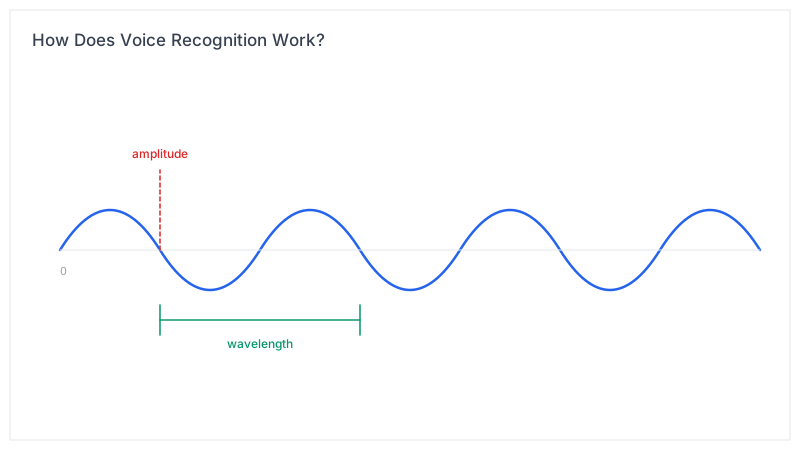
Because spoken sounds overlap and blur, the system keeps several possible interpretations at once and prunes weaker ones, a method that copes with the ambiguity of real speech far better than deciding instantly.
2. What It Means
Raw audio is far too detailed to use directly. A front-end analysis distils it into frames of acoustic features, summarising what frequencies are present every few hundredths of a second.
The heart of modern recognition is a model trained by example. Shown millions of pairs of sound and text, it learns the statistical link between acoustics and spelling without anyone writing rules.
Models also use language habits. Knowing which word sequences are common helps disambiguate sounds that could be several words, just as a human uses context to hear what was said.
3. Why It Happens
People vary enormously: accent, pitch, speed and background noise all change the signal. Training on broad, varied speech is why systems cope with speakers they have never met.
Everything is relative. The same word sounds different from a phone in a car than in a quiet room, so the model learns invariant patterns rather than exact recordings.
Context resolves homophones. Pairs like ‘write’ and ‘right’ sound identical, so the surrounding words decide which the system outputs, which is where the language model earns its keep.
Latency matters in practice. Systems balance accuracy against speed so a spoken command returns an answer quickly enough to feel conversational, often by streaming partial guesses.
4. Real Examples
Smartphone assistants run a compact model on the device for wake words and a larger one in the cloud for full queries, splitting the work by what each setting allows.
Captioning tools apply the same pipeline and then group words into readable lines, which is why errors often come in whole phrases rather than scattered letters.
Voice biometrics is a different task built on overlapping technology: instead of the words, it models the speaker’s vocal signature, which is stable enough to identify a person.
5. How It Affects Us
Recognition quality sets what hands-free use is possible. Good accuracy is what lets drivers, cooks and people with limited mobility control devices by speech.
Errors are uneven. Accented and minority-language speech still underperforms because training data skews toward a few large varieties, a gap with real fairness consequences.
Because transcripts are generated, privacy depends on what happens to them. Whether audio is processed on-device or sent away changes who can later access it.
6. Key Takeaways
- Audio becomes acoustic features, then a trained model maps those to words.
- The model keeps several readings and uses context to choose between them.
- Varied training data is what lets it handle strangers, accents and noise.
- Accuracy is uneven across accents, which carries real fairness implications.