1. Quick Summary
An algorithm is a step-by-step method that always finishes and always produces a result for a defined kind of input. The word carries no magic; it is the formal version of a recipe or a set of directions.
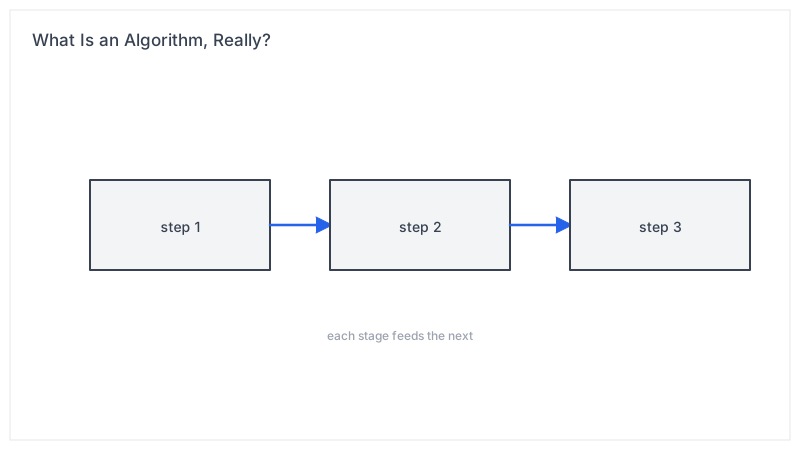
Algorithms are older than computers by millennia. What changed is speed and scale: a machine can run the same clear steps billions of times per second, which is what makes modern software feel powerful.
2. What It Means
Precision is the heart of it. A useful algorithm must leave no ambiguity about what to do next, because a computer will do exactly what is written and nothing it merely implies.
Finiteness matters too. A real algorithm must eventually stop. A set of steps that loops forever has not solved anything, no matter how reasonable each step looks.
Inputs and outputs are defined. An algorithm for sorting expects a list and returns the same list in order; the structure is what lets the same method serve countless different lists.
3. Why It Happens
Algorithms save rethinking. Once a correct procedure exists, anyone or anything can apply it without understanding why it works, which is how complex systems are built from simple reliable parts.
Efficiency is a separate question from correctness. Two sorting methods can both be right while one takes vastly longer on large data, which is why algorithm design studies how cost grows with size.
Many everyday systems are algorithms in disguise. A GPS route, a search ranking and a recommendation feed are each a procedure choosing among options under constraints, not a single answer read from a book.
Machine learning produced new kinds of algorithms whose steps are learned rather than written, which is why they can behave in ways their makers did not explicitly specify.
4. Real Examples
Long division taught in school is a genuine algorithm: the same rules applied repeatedly turn any dividend and divisor into a quotient and remainder.
Binary search is the classic efficiency lesson. To find a name in a sorted list, repeatedly split the range in half, and a list of a million needs at most about twenty checks instead of a million.
A simple recipe fails as an algorithm if it says ‘cook until done’, because done is not defined; turning it into steps with times and targets is what makes it machine-executable.
5. How It Affects Us
Because so much of life now runs through algorithms, understanding the idea protects you from treating their outputs as mysterious truth rather than the product of written choices.
Bias and error enter through the steps and the data, not from nowhere. An algorithm is only as fair and accurate as the procedure and examples behind it.
Knowing the basics also demystifies AI. A modern model is a huge algorithm whose parameters were tuned by another algorithm; the lineage is continuous, not a leap into the unknowable.
6. Key Takeaways
- An algorithm is a finite, unambiguous procedure that turns input into output.
- Correctness and efficiency are different properties; both are studied separately.
- Algorithms predate computers; machines only make them fast and repeatable.
- AI models are algorithms whose steps were learned rather than hand-written.