1. Quick Summary
Earth’s axis is tilted about 23.4 degrees from vertical. As the planet orbits the Sun, that fixed tilt means each hemisphere leans toward the Sun for part of the year and away for the rest.
The result is two things changing together: the height of the Sun in the sky at noon, and the number of daylight hours. Both determine how much solar energy a place receives.
2. What It Means
The common mistake is to think summer happens when Earth is closer to the Sun. It does not. Earth is actually closest to the Sun in early January, during the northern winter.
Distance changes total sunlight by only about 7% over the year. Tilt changes it by several hundred percent at mid and high latitudes.
Two mechanisms matter. First, when the Sun is high overhead its rays strike the ground more directly, concentrating energy into a smaller area. Second, longer days mean more hours of heating.
3. Why It Happens
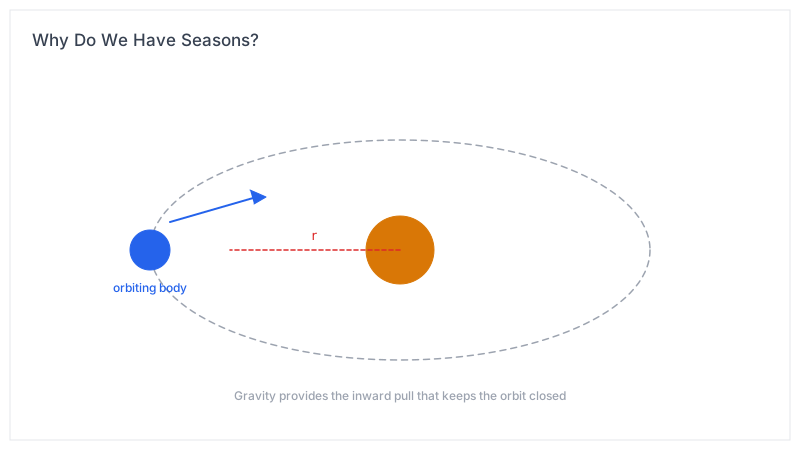
Earth’s orbit is nearly circular — the difference between closest and farthest approach is about 3%. That is far too small to produce seasons.
The tilt stays pointed at the same direction in space all year, roughly toward Polaris. So in June the North Pole leans sunward and in December it leans away.
Around 21 June the Northern Hemisphere reaches the June solstice: the noon Sun is at its highest, daylight is longest, and the pole is in permanent daylight. Six months later it is reversed.
At the equinoxes, around 20 March and 22 September, neither pole leans toward the Sun and every latitude gets about twelve hours of daylight.
The Southern Hemisphere has more ocean, and water heats and cools more slowly than land, so its seasons are somewhat milder even though the geometry is symmetric.
4. Real Examples
At the Arctic Circle on the June solstice the Sun never sets; at the Antarctic Circle it never rises. The same happens in reverse in December.
Singapore sits near the equator, so its noon Sun angle barely changes across the year and its temperatures stay nearly constant — many tropical places have wet and dry seasons instead of warm and cold ones.
Melbourne’s summer in January lines up with the southern solstice, while London’s summer in July lines up with the northern one.
The tilt also produces the analemma — the figure-eight pattern the Sun traces if you photograph it from the same spot at the same time every day for a year.
5. How It Affects Us
Seasons drive agriculture: planting, growing and harvest calendars exist because of the annual sunlight cycle.
They drive animal migration, hibernation, flowering and breeding, which are timed by day length rather than temperature because day length is more reliable.
They shape energy demand — heating peaks in winter, cooling peaks in summer — and therefore shape power grid design.
6. Key Takeaways
- Seasons are caused by axial tilt, not by distance from the Sun.
- Tilt changes both the Sun’s angle and the length of the day; both concentrate or dilute solar energy.
- The hemispheres have opposite seasons at the same time.
- Near the equator the seasons nearly vanish; the effect grows with latitude.