1. Quick Summary
A virtual power plant aggregates many small distributed energy resources — home batteries, electric vehicles, water heaters, heat pumps, commercial refrigeration — and controls them together as one dispatchable resource.
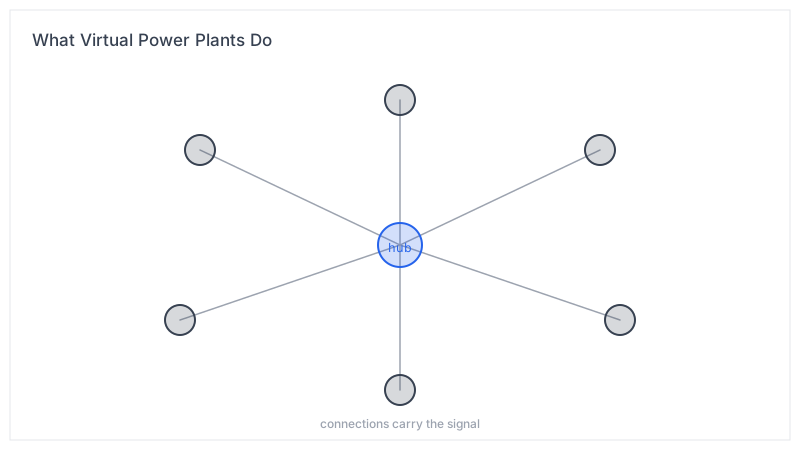
Individually each device is trivial. Coordinated, they can reduce demand or export power at moments when the grid is tight, which is increasingly valuable as wind and solar supply a larger share of electricity.
The appeal is economics. Coordinating existing hardware is usually cheaper per unit of capacity than building new generation or storage, and it uses equipment that was bought for other reasons anyway.
The challenge is reliability and trust. A resource made of thousands of independently owned devices must deliver when called, respect each owner’s needs, and be measured accurately enough to be paid for.
2. What It Means
Two mechanisms are usually bundled under the term. Demand response reduces consumption at a chosen time; distributed generation and storage export power. Both provide the same service to the grid — shifting net load — and are often combined in one fleet.
Coordination happens through software and communications, not physical connection. A central platform forecasts, dispatches and settles with each device, usually through the device manufacturer’s own cloud interface.
3. Why It Happens
Grid value concentrates in a few hours a year. Systems are sized for peak demand, so the ability to shave those peaks avoids building plant that would run rarely — which is why a few hours of availability can be worth a great deal.
Measurement is the hard technical part. To pay for a reduction you must estimate what consumption would otherwise have been, which requires a credible counterfactual baseline rather than a simple before-and-after comparison.
Device diversity is a strength. Water heaters and buildings have thermal mass, so shifting their consumption by an hour is barely noticeable; batteries can respond in seconds. Different resources suit different services.
Participation depends on owners. If joining is complicated, pays badly, or threatens comfort, uptake stalls — and fleet size determines whether the resource is worth anything to the grid at all.
4. Real Examples
Home battery fleets: discharging during evening peaks, with owners paid for availability rather than only for energy delivered.
Water heater and heat pump control: shifting heating slightly earlier or later within an acceptable temperature band.
Electric vehicle charging: slowing or delaying charging when the grid is strained, usually with an override for when the driver needs the range.
Commercial refrigeration and cold storage: using thermal inertia to ride through short price or reliability events.
5. How It Affects Us
For households, participation typically trades a small amount of convenience or control for payments or lower tariffs. Reading the terms — especially override rights and battery cycling limits — matters.
For grid operators, aggregated distributed resources are becoming a mainstream planning input rather than a novelty pilot.
For reliability, the question is whether the fleet performs in exactly the rare, stressed conditions when it is needed, which is harder to guarantee than average performance.
For equity, the benefits currently flow mostly to households that can afford batteries or smart devices, which is a recognised policy concern.
6. Key Takeaways
- A virtual power plant coordinates many small devices to act as one dispatchable grid resource.
- It provides both demand reduction and distributed export, which are equivalent services to the grid.
- Baseline estimation — what would have happened otherwise — is the core technical difficulty.
- Value concentrates in the few highest-stress hours of the year.
- Owner participation, trust and fair compensation determine whether a fleet is viable.