1. Quick Summary
Neuroplasticity is the brain’s ability to change its structure and function in response to experience, learning, injury or changes in input.
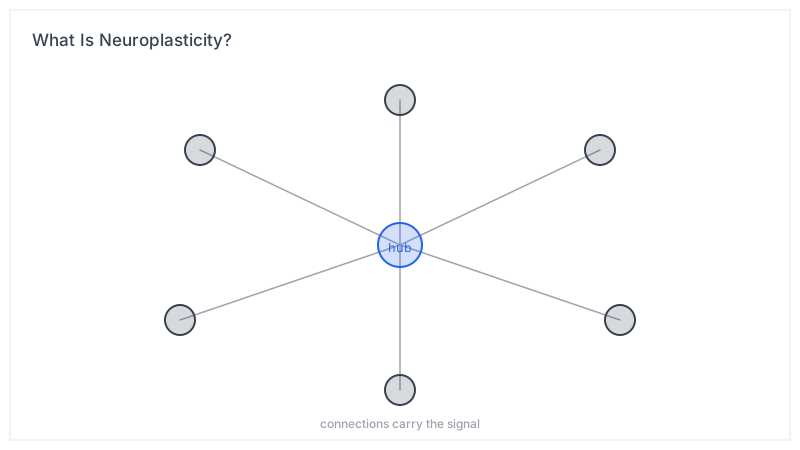
It operates at several scales: individual synapses strengthen or weaken, connections sprout or retract, and whole cortical areas can take on new roles.
2. What It Means
The core mechanism is that connections between neurons change strength depending on activity. Patterns that fire together tend to wire together.
Long-term potentiation strengthens repeatedly used pathways, while long-term depression weakens underused ones — both are essential, because only strengthening everything would saturate the system.
This is not limited to childhood. Adult brains remain plastic, though the balance shifts: younger brains change more readily, adult brains change more selectively.
3. Why It Happens
Hebbian learning is the basic rule: if neuron A repeatedly helps fire neuron B, the connection between them strengthens.
Synaptic plasticity happens in minutes to hours, while structural changes such as new dendritic spines take days.
Cortical remapping is the dramatic version. In people blind from birth, the visual cortex is recruited for touch and reading Braille; in amputees, the area that served the missing limb responds to neighbouring body parts.
Chemical and structural brakes exist too. Myelin and perineuronal nets stabilise circuits once they are established, which is why adult plasticity requires focused, repeated, attention-driven practice.
Sleep and consolidation matter: plasticity during practice is only the first step, and offline replay during sleep appears to be where much of the stabilisation happens.
4. Real Examples
London taxi drivers who learned the city’s street layout showed measurable changes in hippocampal structure, which reversed after they stopped navigating.
Stroke rehabilitation works by driving repetitive, task-specific practice that pushes surviving circuits to take over lost functions.
Musicians have enlarged cortical representations for the fingers they use most, with larger effects in those who started young.
Phantom limb pain is partly a plasticity failure — the cortex remaps in a way that produces sensation from a limb that no longer exists.
5. How It Affects Us
It underpins education: spaced, effortful, attention-rich practice produces change, while passive exposure largely does not.
It gives a biological basis for habit change — repeatedly redirecting a behaviour strengthens competing circuits rather than erasing the old ones.
It also explains why early intervention matters: plasticity is greatest early, so deprivation or enrichment has outsized effects in childhood.
6. Key Takeaways
- Neuroplasticity is experience-driven change in brain structure and function, lifelong rather than childhood-only.
- Strengthening and weakening both matter; the brain prunes as much as it builds.
- Adult plasticity is real but requires repeated, focused, attended practice.
- It is the mechanism behind learning, rehabilitation and habit change.