1. Quick Summary
Gravity is a force of attraction between any two objects that have mass, pulling them toward each other.
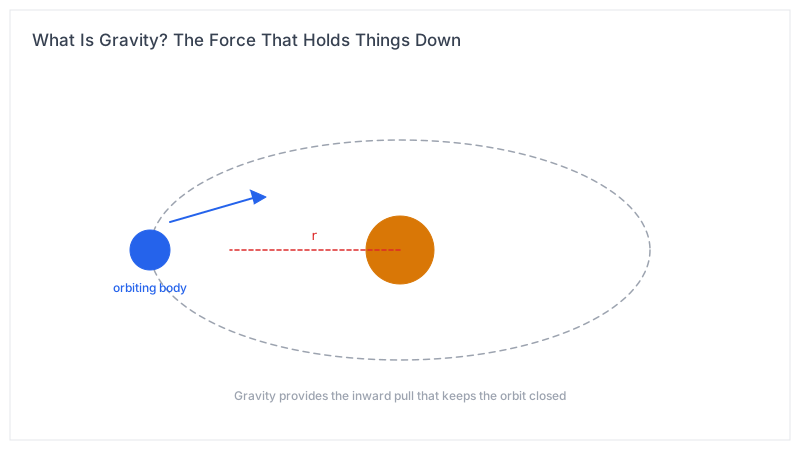
The bigger the mass, the stronger the pull, which is why Earth’s gravity easily holds us down but a book’s pull on you is too small to feel.
It reaches across empty space, which is how the Moon stays near Earth and Earth stays near the Sun.
2. What It Means
Mass is the amount of stuff in an object, and gravity is proportional to mass, so doubling mass roughly doubles the pull it exerts.
Distance matters too: the pull weakens quickly as objects move apart, which is why distant stars do not yank us around.
3. Why It Happens
Newton described gravity as a universal pull and used it to explain falling apples and orbiting planets with one rule.
Einstein later showed gravity is also the bending of space and time by mass, like a heavy ball denting a trampoline so lighter balls roll toward it.
That bending explains small puzzles Newton could not, such as tiny shifts in Mercury’s orbit near the massive Sun.
4. Real Examples
The Moon’s gravity pulls Earth’s oceans, creating the daily rhythm of tides.
Astronauts float in orbit not because gravity vanishes, but because they are falling around Earth together with their capsule.
A dropped key accelerates downward at the same rate as a heavy rock, ignoring air, a classic gravity result.
5. How It Affects Us
Gravity gives weight to everything and shapes the structure of stars, planets, and galaxies.
It keeps our atmosphere from drifting into space, which is why life can breathe and water can stay liquid.
Understanding it lets us launch satellites and plan missions, steering craft using gravity as a helper.
6. Key Takeaways
- Gravity is the attraction between masses, stronger with more mass and weaker with distance.
- Newton framed it as a force; Einstein as the bending of space and time by mass.
- It holds the cosmos together and keeps our air and water on Earth.