1. Quick Summary
Simple interest pays a fixed percentage of the original amount every period. Compound interest adds each period’s interest to the balance, so the next period’s interest is calculated on a larger base.
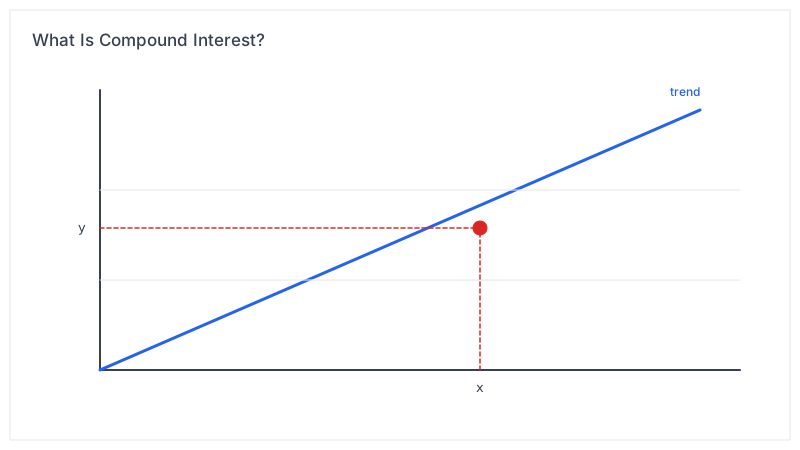
The difference looks small over a few years and becomes enormous over decades, because the growth is exponential rather than linear.
2. What It Means
Mathematically, a balance growing at rate r per period compounds to (1 + r) raised to the number of periods. Growth feeds on itself.
The rule of 72 is a quick approximation: divide 72 by the annual percentage rate to get roughly how many years it takes money to double.
The same mathematics applies in reverse to debt. A credit card balance compounding at 20% a year grows just as fast as an investment earning 20%.
3. Why It Happens
Each period, the interest earned in previous periods becomes part of the principal. That is the whole mechanism.
Compounding frequency matters, but with diminishing returns. Going from yearly to monthly helps noticeably; going from monthly to daily helps very little.
Time matters more than rate early on, because the exponent is the number of periods. Starting ten years earlier often beats earning a higher rate for a shorter span.
Inflation is a form of negative compounding on purchasing power. The number that actually matters is the real return — the nominal rate minus inflation.
Fees compound too. A seemingly small annual percentage fee subtracted each year can consume a large share of a long-term portfolio.
4. Real Examples
At 7% a year, 100 units becomes about 197 in ten years, 387 in twenty, and roughly 761 in thirty — most of the thirty-year gain arrives in the last decade.
A balance at 20% annual interest doubles in under four years if unpaid, which is why minimum payments on high-rate cards barely reduce the principal.
Retirement contributions made in your twenties typically end up worth more at retirement than larger contributions started in your forties.
Population growth, the spread of a virus and the accumulation of knowledge all follow the same compounding mathematics.
5. How It Affects Us
It is the central reason long-term investing works and the central reason high-interest consumer debt is dangerous.
Pension systems, student loans and mortgages are all structured around how compounding behaves over decades.
Understanding it changes behaviour more than any particular product: start earlier, cut fees, and avoid high-rate debt.
6. Key Takeaways
- Compounding means interest earns interest, producing exponential rather than linear growth.
- Time in the market generally matters more than squeezing out a higher rate.
- It cuts both ways — it is just as powerful against borrowers as it is for savers.
- Always compare returns after inflation and after fees.