1. Quick Summary
Most earthquakes begin at faults, where plates or blocks of crust grind past one another. The rock deforms slowly under the strain but the contact resists moving, so energy accumulates like a bent spring.
When the stress exceeds the rock’s grip, the surfaces slip suddenly. The motion sends vibrations outward in every direction, and those vibrations are the shaking we feel.
2. What It Means
The ground is not one solid shell but a cracked surface divided into plates that drift a few centimetres per year. Their boundaries are where most quakes occur, because that is where relative motion concentrates.
Elastic rebound is the core idea: rock stores deformation elastically until it fails. After a slip, the rock on each side springs back partway toward its unstrained shape, exactly as a released rubber band would.
The point where rupture starts underground is the hypocenter; the point directly above it on the surface is the epicenter. Distance from these determines both arrival time and how much the waves have weakened.
3. Why It Happens
Sharp boundaries between plates, such as the San Andreas, allow sideways creep with frequent moderate quakes; where one plate dives beneath another, great quakes build over centuries before releasing at once.
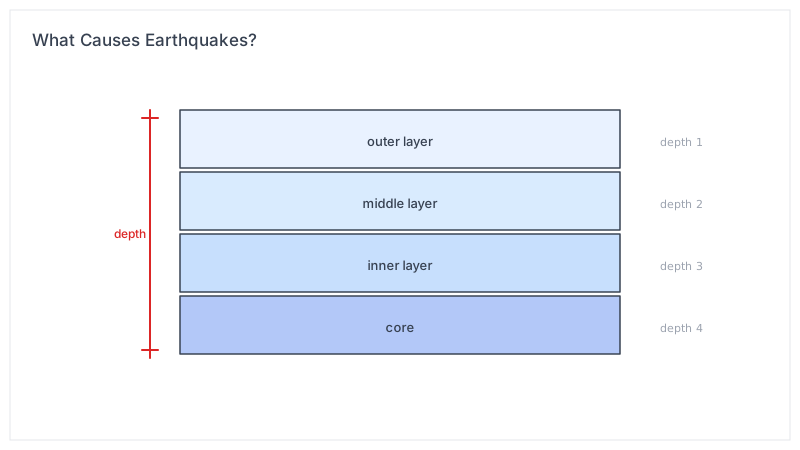
Depth strongly controls the felt effect. Shallow quakes carry more energy to the surface, while deep ones dissipate more on the way up and often pass unnoticed by anyone standing above.
Loose or wet ground amplifies shaking. Soft sediment and fill can shake far more violently than solid rock nearby, which is why damage patterns follow geology as much as distance.
Aftershocks are not a separate mechanism but the fault settling. The main rupture changes stress nearby, and smaller slips relieve that changed stress over hours, days and sometimes years.
4. Real Examples
The 1906 San Francisco earthquake ruptured a long stretch of coastal California, and studies of offset fences gave early direct evidence for elastic rebound.
The 2011 Tohoku quake off Japan was a subduction event that moved the seafloor enough to generate a trans-oceanic tsunami detected across the Pacific.
Induced earthquakes near some oil and gas operations come from fluid injected underground changing pressures on existing faults, a reminder that stress release needs no great depth to be felt.
5. How It Affects Us
Prediction remains out of reach because the exact failure instant is not simply the moment stress passes a threshold; small details of friction decide timing, and those are not observable in advance.
What works instead is preparation and early warning. Detecting the fast but harmless first wave lets systems issue seconds of alert before the slower, damaging wave arrives.
Building practice matters more than the quake itself. Regions with enforced seismic codes suffer far less collapse for the same ground motion than regions without them.
6. Key Takeaways
- Earthquakes come from sudden slip on a fault after stress builds against friction.
- Elastic rebound explains how bent rock springs back when it finally moves.
- Shallow quakes, soft ground and aftershocks all shape how much damage occurs.
- Reliable prediction is not yet possible; preparation and warning are what reduce harm.