1. Quick Summary
Inside every microwave is a component that emits electromagnetic waves at about 2.45 gigahertz. Water molecules are electrically lopsided, so the oscillating field keeps trying to twist them into alignment and that twisting generates heat.
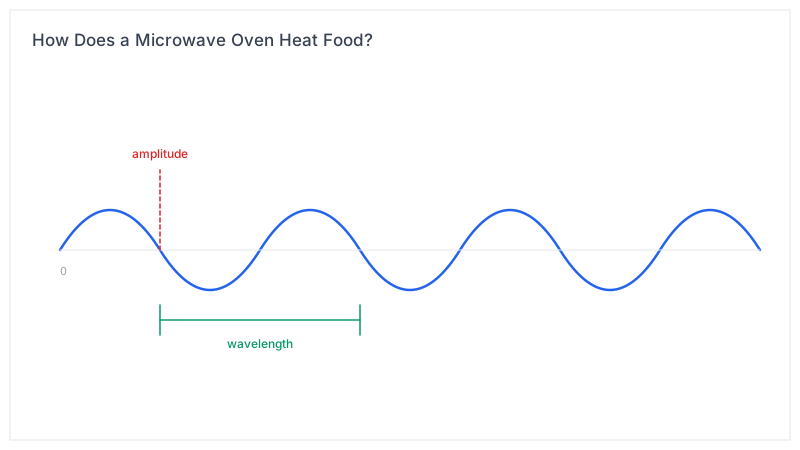
Because the waves penetrate several centimetres into food, some heating happens through the interior rather than only at the surface, unlike a conventional oven which heats from outside in.
2. What It Means
A water molecule has a positive end and a negative end, which makes it a dipole. In an alternating electric field it experiences torque and rotates back and forth billions of times a second.
Rotating molecules jostle their neighbours, and that molecular-scale jostling is precisely what heat is. The energy goes directly into motion rather than arriving as heat through a surface.
The specific frequency is a compromise. It is absorbed readily enough to heat food quickly, yet not so readily that all the energy is dumped into the outermost millimetre.
3. Why It Happens
Metal reflects microwaves rather than absorbing them, so the oven cavity acts as a reflective box bouncing waves around until food takes them up. This is also why metal objects inside can spark at sharp edges.
The door has a metal screen with holes far smaller than the microwave wavelength. To a 12-centimetre wave it behaves like solid metal, while visible light passes through easily, letting you watch without leaking.
Heating is uneven because the waves form standing patterns inside the cavity, leaving predictable hot and cold spots. The turntable exists to move food through those zones, and modern designs sometimes stir the beam instead.
Frozen food heats slowly and unevenly because ice absorbs microwaves far less readily than liquid water does. Once part of it thaws, that region heats rapidly while adjacent frozen areas lag behind.
4. Real Examples
A mug of water can end up superheated past boiling without bubbling, because a smooth container offers few nucleation sites. Disturbing it afterwards can make it boil violently, which is why a non-metal stirrer left in the cup helps.
Grapes famously produce plasma when microwaved whole, at least when halves are joined by a thin strip of skin. The connection concentrates the field at the bridge and ionises the air there.
Thin and dry items such as crisps or crackers barely warm because they contain little water. Anything that heats quickly after sitting out has usually absorbed moisture from the air.
5. How It Affects Us
The heating pattern explains the standing-time instruction on packaging. During standing, conduction continues spreading heat from hot regions into cooler ones, evening things out without any further input.
Container choice follows directly from the physics: glass and most ceramics are transparent to microwaves and stay relatively cool, while anything metal should stay out.
Compared with an oven, the microwave is efficient for small wet items because energy goes into the food rather than into heating a large volume of air and metal first.
6. Key Takeaways
- Microwaves rotate water molecules and that rotation becomes heat.
- The waves penetrate several centimetres, so heating is partly internal.
- Metal reflects microwaves and should not go inside; the door screen works because of wavelength.
- Uneven heating comes from standing wave patterns, which turntables and stirrers mitigate.