1. Quick Summary
Sound begins with something vibrating, like a plucked string or a speaker cone, which shakes the air around it.
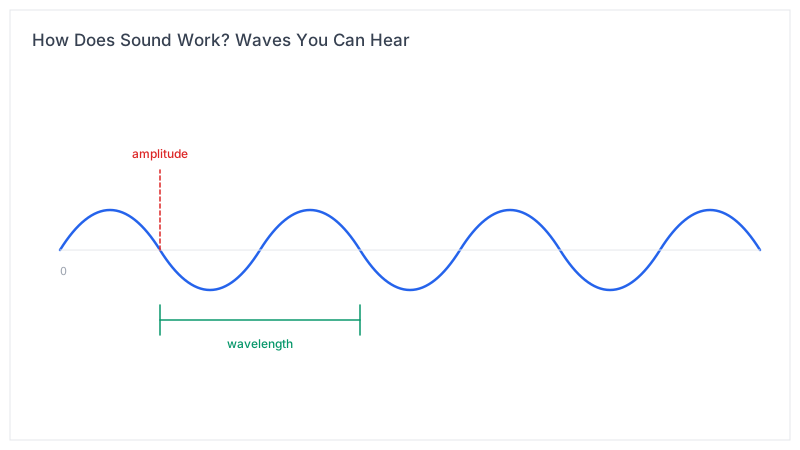
That shaking spreads as a wave of pressure moving outward, the way ripples move across a pond after a stone drops.
When the wave reaches your ear, it vibrates tiny parts that the brain reads as a sound.
2. What It Means
Frequency is how fast the wave repeats, and we hear that as pitch: faster vibrations sound higher, slower ones lower.
Loudness comes from the wave’s size, or amplitude; a bigger push on the air makes a stronger signal the ear can detect as louder.
3. Why It Happens
Sound needs a medium, so it travels through air, water, and walls, but not through empty space, which is why explosions in space are silent in films but not in reality.
Different materials pass sound at different speeds; it moves faster through water and metal than through air because their particles are closer.
Your ear sorts the wave by frequency and the brain labels it as voice, music, or noise using experience, not just the raw vibration.
4. Real Examples
A drum’s skin vibrates and you feel the thump in your chest because the air pressure wave is strong and low.
Underwater, a friend’s voice sounds odd because sound travels differently and your ears are tuned for air.
Echoes happen when a wave bounces off a wall and returns, delayed by the distance it had to travel.
5. How It Affects Us
Sound carries language, music, and warning, shaping how humans and animals connect and survive.
Because it fades with distance and is blocked by vacuums, it sets limits on how we sense the world.
Managing sound, through quiet spaces or hearing protection, protects a sense many people take for granted.
6. Key Takeaways
- Sound is a pressure wave made by vibration traveling through a medium like air.
- Pitch is frequency and loudness is amplitude, read by the ear and brain.
- It needs matter to move, so there is no sound in empty space.