1. Quick Summary
A rainbow needs two things at once: the sun behind you and rain in front of you. Each raindrop acts like a tiny prism, bending light and sending a fan of colours back toward your eye.
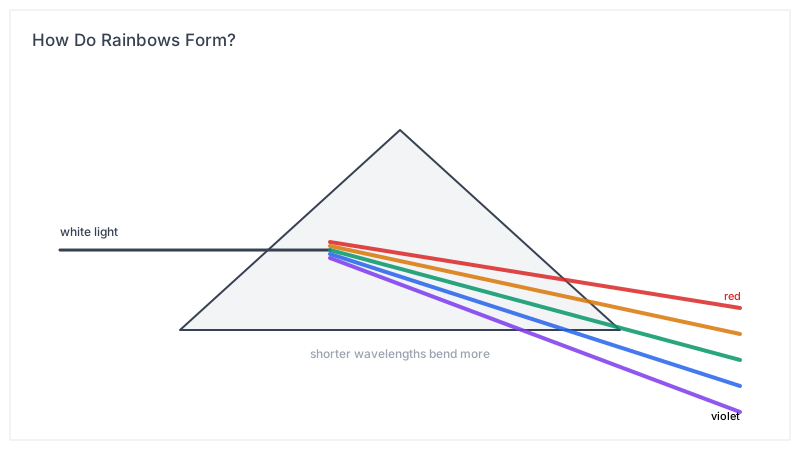
The arc is not a physical object but a direction. Every observer sees their own rainbow made by different drops, which is why you can never reach the end of one.
2. What It Means
Light slows and bends when it enters water from air, an effect called refraction. As it leaves, part reflects off the inside back surface of the drop and bends again on exit.
White sunlight is a mixture of colours, and each colour refracts by a slightly different angle. Red bends least, violet most, so the single white beam leaves the drop spread into a spectrum.
Only one angle reaches your eye from each drop. Drops at the right height send red, those slightly lower send blue, and together they paint the familiar stacked bands.
3. Why It Happens
The 42-degree geometry is why the bow is round. Drops that form the red band all sit at the same angle from the anti-solar point, the point directly opposite the sun, so they trace a circle around it.
We usually see an arc because the ground cuts off the lower half. From a plane or a high hill the full circle can appear, confirming the shape was always circular.
A second, fainter bow comes from light reflecting twice inside the drops. Its colours are reversed and it sits outside the primary, the signature of the double reflection.
Drop size affects sharpness. Uniform small drops give crisp bands; large uneven drops blur them, which is why some rainbows look cleaner than others.
4. Real Examples
A garden hose in bright sun can make a rainbow if you stand with your back to the light and angle the spray just so, reproducing the raindrop effect at arm’s length.
Moonbows exist too, lit by the moon, but they are faint and usually appear white to the eye because dim light engages fewer colour sensors.
Fogbows are broad and pale, formed by tiny droplets that scatter light too much to resolve sharp colour, the same physics at a smaller scale.
5. How It Affects Us
The mechanism explains why you must face away from the sun to see one. The bow is always centred opposite the light source, a fact that helps you find it after rain.
It also explains the order: red on the outside of the primary bow, because red leaves drops at the largest angle. The reversed secondary bow is the giveaway of double reflection.
Knowing it is geometry rather than magic makes the phenomenon more, not less, remarkable: a sky-wide optical instrument built from falling water.
6. Key Takeaways
- Rainbows need sun behind you and rain in front, each drop acting as a prism.
- Refraction plus internal reflection spreads white light into colour by angle.
- The arc is a 42-degree circle around the point opposite the sun, cut by the ground.
- A fainter outer bow with reversed colours comes from a second internal reflection.