1. Quick Summary
A yawn is more than a big breath. It involves a long inhale, a brief hold, and a stretched exhale, with the soft palate and jaw tensing as part of the motion.
No single explanation is settled, but the strongest current ideas connect yawning to regulating the brain’s temperature and to marking a change in state, such as waking, winding down, or preparing to focus.
2. What It Means
Yawning increases blood flow to the head and draws in cooler air, both of which can help bring an overheated brain back toward its optimal range. The cooling idea is supported by yawning rising in warm conditions and falling in cool ones.
It also clusters around transitions. People yawn when tired, when bored, and when waking, all moments when the brain is shifting gears between arousal states.
Contagion is a separate puzzle. Seeing or hearing someone yawn makes many people yawn too, and this appears earlier in development alongside social awareness, which is why it is studied as a social signal.
3. Why It Happens
Brain cooling fits a pattern: yawning is more frequent when the body is warm and less frequent when ambient air is already cool, suggesting the behaviour is doing thermoregulation rather than only signalling tiredness.
The stretch component may help. Tensing the jaw and ear muscles could open the Eustachian tube and equalise pressure, a minor benefit that travels along with the main motion.
State-shift accounts note that yawning precedes both sleep and bursts of effort. Athletes and performers often yawn before competition, consistent with the body preparing to change mode rather than shutting down.
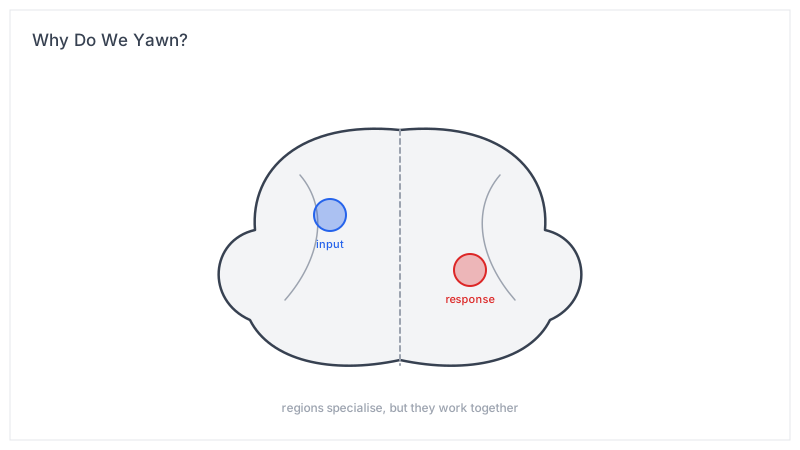
Contagion likely builds on the same circuits that let us mirror others. Because it emerges with social cognition, researchers use it as a window into empathy and neurologic condition rather than as a mere reflex.
4. Real Examples
People yawn more in stuffy warm rooms than in cool fresh air, which is the everyday version of the brain-cooling hypothesis.
Paratroopers in one study yawned more before a jump than after landing, matching the idea of yawning before a demanding task rather than only from drowsiness.
Chimpanzees and dogs show contagious yawning too, and in dogs it is stronger toward familiar humans, hinting the response is tied to social bonds across species.
5. How It Affects Us
Excessive yawning can be a clue rather than a nuisance. Frequent yawning alongside other signs sometimes points to poor sleep, low oxygen, or a need to check with a clinician.
For everyday life the honest answer is that a yawn is normal and multifunctional; it is not reliable evidence of boredom even though it is often read that way.
Trying to suppress a yawn usually fails, which itself suggests the behaviour serves a physical function the body wants completed, whether cooling or resetting.
6. Key Takeaways
- A yawn pairs a deep breath with jaw and palate tension, not just a big inhale.
- Brain cooling and state-shifting are the leading functional explanations.
- Yawning is contagious through social-mirroring circuits, not just imitation.
- Frequent yawning can be a signal worth noticing rather than a trivial habit.