1. Quick Summary
Emotions are contagious in a literal sense. Spending time with someone anxious, cheerful or angry shifts our own state, often before we are consciously aware of why.
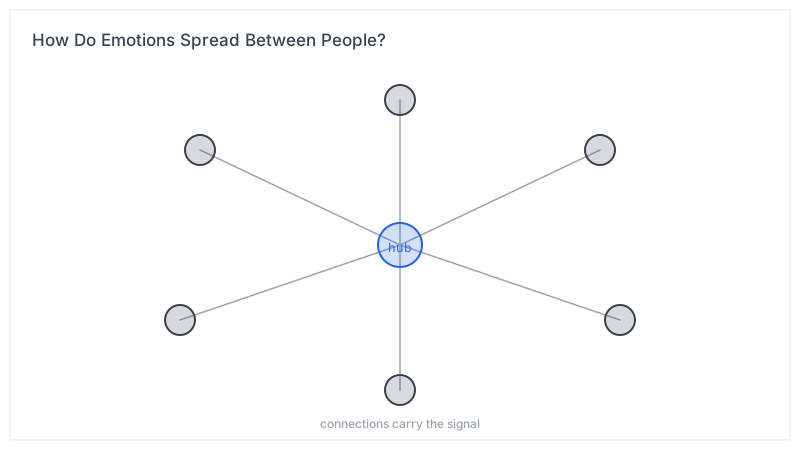
The mechanism is partly wiring: humans are built to imitate. Mirroring another’s expression or tone recruits overlapping brain circuits, which nudges us toward feeling something similar.
2. What It Means
Faces are read continuously and largely outside awareness. A brief flash of fear or joy on someone nearby is processed fast enough to shift our own physiology within moments.
Vocal tone carries mood even when words do not. A flat sentence spoken with tension reads as tense, which is why a phone call can change your mood without any information changing.
Bodily feedback closes the loop. When we mirror a posture or expression, the associated feeling tends to follow, so imitation is not only a signal but a cause of shared emotion.
3. Why It Happens
This sensitivity is adaptive. Coordinating emotional state helps groups respond together to threats and bond over good news, which mattered enormously before language was rich.
Social rank and closeness shape direction. Emotion tends to flow from the more expressive or higher-status person to others more than the reverse, which is why a leader’s mood weighs on a room.
Digital contact spreads it too, though more weakly. Reading angry posts can lift your own irritability even without a face present, because the content still primes the same circuits.
Fatigue and stress raise susceptibility. When depleted we regulate less well, which is part of why tense moods seem to sweep through tired teams more easily.
4. Real Examples
Audiences at comedy shows laugh more in a group than alone; the shared reaction is not performance but genuine contagion of amusement through sound and movement.
Care workers and partners of anxious people often report absorbing that anxiety, a common and measurable effect of sustained close contact.
Online outrage spreads through networks far faster than calm corrections, because strong negative emotion is both more motivating to share and more contagious on arrival.
5. How It Affects Us
Because mood is catchable, environment is partly a choice. Surrounding yourself with steady, supportive people is a real lever on day-to-day emotional state.
In teams it argues for managing the most visible moods first. One person’s chronic irritation can tax everyone, while one calm presence can lower the room’s baseline.
Awareness helps. Noticing that a feeling may be borrowed rather than yours gives a chance to set it down instead of acting on it.
6. Key Takeaways
- We mirror faces, voices and posture automatically, which transmits feeling.
- Emotion flows more strongly from expressive or higher-status people to others.
- The effect is older than language and helped groups coordinate and bond.
- Noticing a borrowed mood is the first step to not being ruled by it.