1. Quick Summary
All clocks work the same basic way: they count regular, repeating events and convert the count into hours, minutes, and seconds.
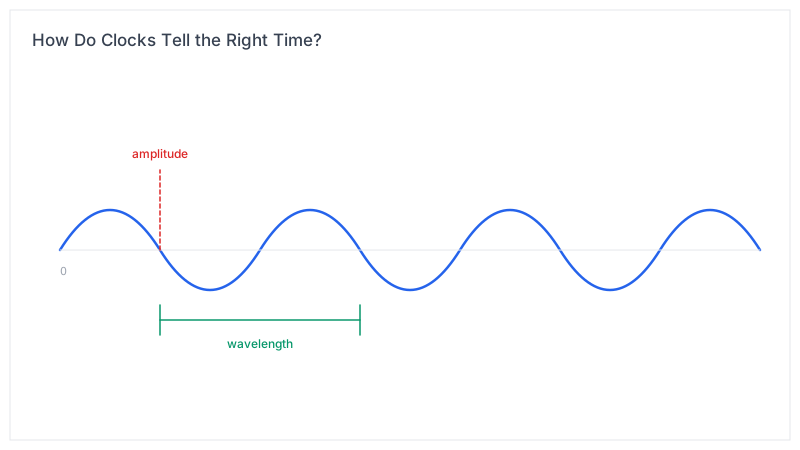
A pendulum, a tuning fork, a quartz crystal, or even atoms can serve as the steady ‘tick’ being counted.
2. What It Means
A clock is a counter, not a magic box. It just counts something that happens over and over at the same speed.
The better the ‘tick’ stays steady, the more accurate the clock.
3. Why It Happens
Mechanical clocks used a swinging pendulum whose period depends mainly on its length, not how hard it swings.
Quartz clocks use a crystal that vibrates at a precise frequency when electricity passes through it — thousands of ticks per second.
Atomic clocks measure the vibration of atoms (like cesium) and are so stable they would gain or lose less than a second over millions of years.
4. Real Examples
A grandfather clock’s pendulum swings back and forth, each swing advancing the gears by a fixed amount.
Your phone syncs to atomic clocks via GPS satellites so its time stays correct to the fraction of a second.
5. How It Affects Us
Accurate time keeps schedules, networks, and navigation working. Modern systems like the internet and air travel depend on it.
Time zones and leap seconds are human adjustments layered on top of the steady physical tick.
6. Key Takeaways
- Clocks count steady, repeating events — pendulum swings, crystal vibrations, or atomic transitions.
- The steadier the event, the more accurate the clock, from grandfather clocks to atomic standards.