1. Quick Summary
A black hole is a place where gravity is so intense that anything crossing its edge, even light, cannot get back out.
It forms when a very massive star runs out of fuel and collapses under its own weight into a tiny, dense point.
We cannot see it directly, but we infer it from how it bends light and drags nearby matter into a hot, bright swirl.
2. What It Means
The edge, called the event horizon, is the boundary where escape speed exceeds the speed of light, so nothing inside can return.
The mass stays, concentrated, which is why a black hole still pulls on surrounding stars and gas through ordinary gravity.
3. Why It Happens
Collapse happens because massive stars fight gravity with the heat of fusion; when the fuel ends, gravity wins and squeezes the core without limit.
Rotation and charge shape the details, but the event horizon and mass are what mostly define what we can observe.
Falling matter heats by friction into a glowing disk, which is often the bright sign that reveals a hidden hole.
4. Real Examples
The first picture of a black hole showed a dark center ringed by the glow of its hot surrounding disk.
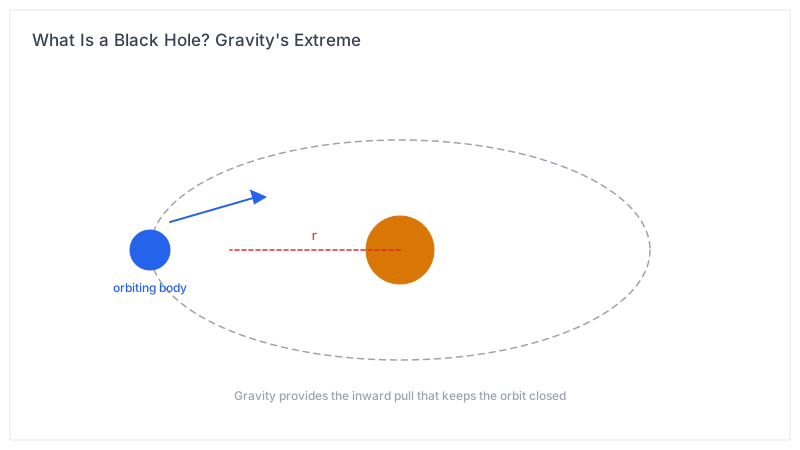
Our galaxy’s center holds a giant black hole millions of times the Sun’s mass, revealed by stars orbiting an invisible heavy point.
Near one, time itself slows relative to far away, a prediction of relativity that extreme gravity makes real.
5. How It Affects Us
Black holes are laboratories for gravity at its strongest, testing ideas that shape modern physics.
They help anchor galaxies, their growth linked to how the galaxies around them formed and changed.
They show that ‘invisible’ need not mean unknowable, since its effects on light and matter betray its presence.
6. Key Takeaways
- A black hole is a region where gravity traps even light past its event horizon.
- It forms from the collapse of a massive star’s core when fusion stops.
- We detect it by its pull on nearby matter and the glow of infalling gas.