1. Quick Summary
A magnet has two ends, a north and a south pole, and it attracts iron, nickel, and a few other metals from a distance.
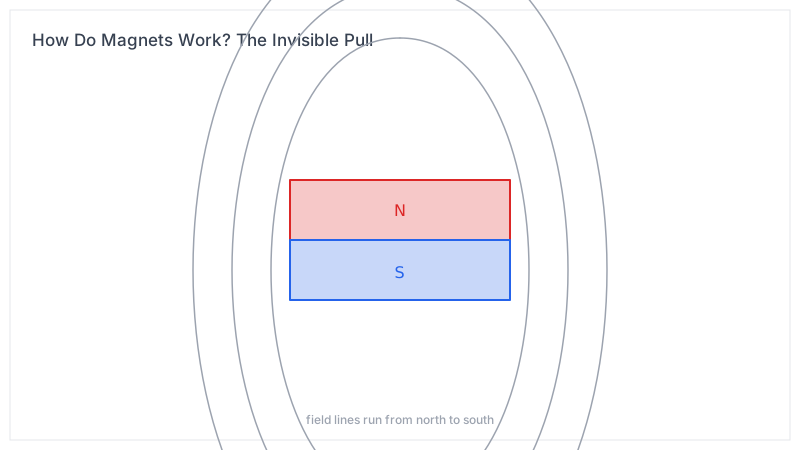
The pull comes from a magnetic field, an invisible region around the magnet where its force acts on other magnetic materials.
Inside, the magnet’s atoms act like tiny compass needles that all point the same way, which is what makes the whole object magnetic.
2. What It Means
Electrons behave like tiny spinning charges, and that spin gives each one a small magnetic direction; in most materials these cancel out, but in a magnet they add up.
When many atomic magnets align in the same direction, their individual fields combine into one strong field around the object.
3. Why It Happens
Alignment is the secret: heating or dropping a magnet can jumble those tiny directions, which is why a strong magnet can lose its power.
Opposite poles attract and like poles repel because field lines flow from north to south and push against each other when matched.
Electricity and magnetism are linked: a moving electric current makes a magnetic field, which is how electromagnets and motors work.
4. Real Examples
A fridge magnet stays up because its field pulls on the steel door across a tiny gap.
Earth itself is a giant magnet, which is why a compass needle points roughly north.
Scrap yards lift cars with electromagnets that switch on with current and release when the current stops.
5. How It Affects Us
Magnets are inside speakers, hard drives, generators, and the motors that move countless devices.
Because their field is invisible, people often underestimate how much modern life depends on controlled magnetism.
Understanding them helps design cleaner energy, from wind turbines to maglev trains that float on magnetic repulsion.
6. Key Takeaways
- Magnets attract some metals through an invisible magnetic field.
- Their power comes from countless tiny atomic magnets all pointing the same way.
- Magnetism and electricity are two sides of one force behind much of today’s technology.