1. Quick Summary
GPS is a network of satellites that constantly broadcast their location and the exact time from atomic clocks.
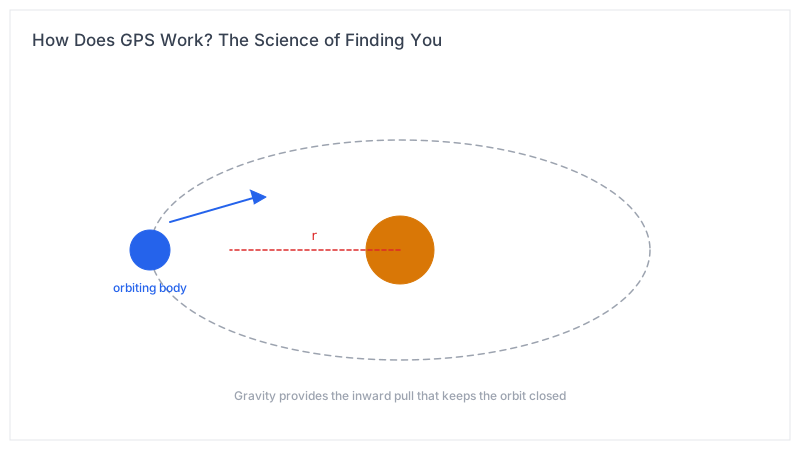
Your phone or car receiver catches signals from several of these satellites and compares the tiny arrival times to work out its distance from each.
Using distances from at least four satellites, the receiver calculates your position in three dimensions: latitude, longitude, and altitude.
2. What It Means
The core trick is timing. Because radio travels at a known speed, the gap between when a signal was sent and when it arrives tells the distance to that satellite.
This is called trilateration: where three spheres of known radius meet, there is only one point, and that point is you.
3. Why It Happens
Satellites carry atomic clocks accurate to billionths of a second, because even a tiny timing error becomes a large position error over the vast distance to Earth.
At least four satellites are used so the receiver can also solve for the time offset in its own cheap clock, which is never as precise as the satellites’.
The signals are weak on purpose so they stay within a region, and they pass through clouds and plastic but not solid buildings, which is why GPS drops in tunnels.
4. Real Examples
A map app places your blue dot by mixing GPS with nearby Wi-Fi and cell towers, which helps when satellites are blocked by buildings.
Airplanes and ships rely on GPS for navigation, and farms use it to steer tractors in straight lines with centimeter-level correction.
Emergency calls use GPS to pinpoint a caller, which is why location accuracy can matter for rescue.
5. How It Affects Us
GPS made turn-by-turn navigation ordinary, replacing paper maps for most daily travel.
It underpins timing for power grids, stock trades, and phone networks, all of which need synchronized clocks.
Because so much depends on it, governments treat GPS as critical infrastructure and run backup systems in case it is jammed.
6. Key Takeaways
- GPS locates you by timing radio signals from orbiting satellites with atomic clocks.
- Distances from several satellites meet at a single point that is your position.
- It powers far more than maps, including the timing behind modern networks.